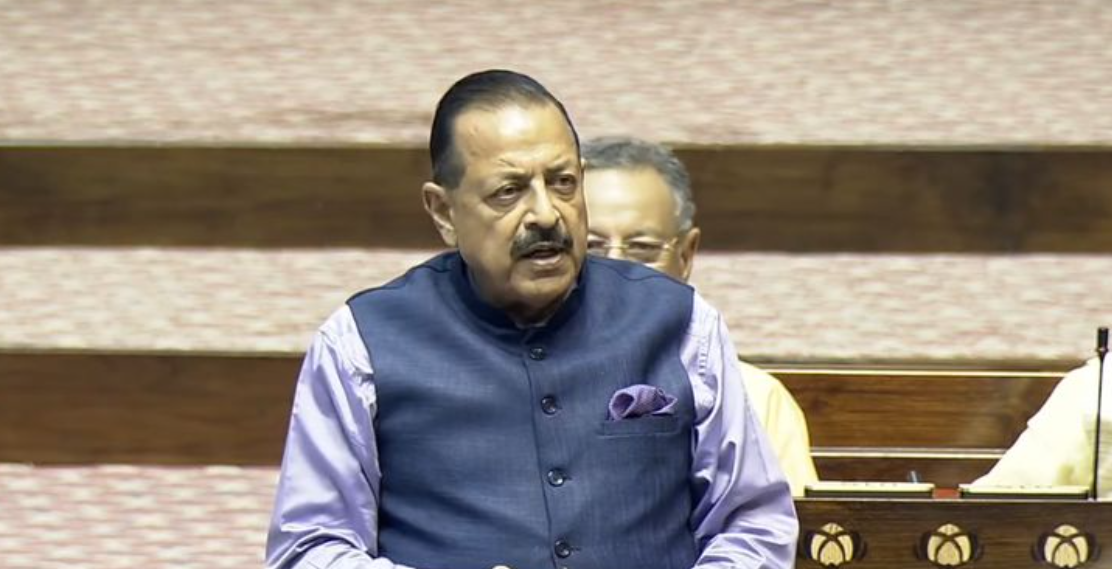
New Delhi, Jul 30: A series of reforms have been undertaken to make recruitment to central government jobs through the Union Public Service Commission (UPSC) and the Staff Selection Commission (SSC) faster, more transparent and secure, including measures to enhance the credibility and integrity of competitive exams, Union Minister Jitendra Singh said on Thursday.
There are two recruitment agencies under the administrative control of the Department of Personnel and Training (DoPT) — Staff Selection Commission (SSC) and Union Public Service Commission (UPSC), he said in a written reply to the Rajya Sabha.
The UPSC has introduced several reforms which have reduced the recruitment cycle further from over 15 months to about 13 months, said Singh, the Minister of State for Personnel.
The reforms include a modular online application portal to simplify the application process, AI-based verification of civil services examination attempts, face authentication to prevent impersonation and release of provisional answer keys with a structured representation mechanism, he said.
The UPSC has also established a dedicated candidate helpdesk, expanded examination centres to additional locations and introduced a guaranteed choice of examination centre for Persons with Disabilities (PwD), the minister said.
He mentioned that the SSC has implemented a comprehensive set of administrative and technology-driven reforms to strengthen the integrity, transparency, efficiency, and security of its examinations.
Recruitment cycles have been reduced from 15–18 months to an average of 6-8 months with reduced examination tiers and implementation of computer-based examinations. The SSC has introduced a secure ‘e-dossier’ system for tamper-proof, swift and secure digital document communication, Singh said.
The SSC has also launched a sliding mechanism framework to maximise vacancy utilisation through merit-based post upgradation.
Transparency has been enhanced by publishing tentative and final answer keys, inviting candidate objections, lowering challenge fee, and releasing marks and results online, the minister said.
Interview for appointment to Group ‘C’ and Group ‘B’ (non-gazetted) posts has been dispensed with effect from January 1, 2016, to expedite the recruitment process and to ensure fairness and objectivity in recruitment examinations, Singh said.
Provisional appointment letters can be issued based on self-attestation alongside a six-month time limit for both character and caste certificate verifications, the minister said.
Recruitment for the vacant posts has been undertaken in a time-bound and mission-mode manner by all ministries/departments and government organisations, and several lakh appointment letters have been distributed through National Rozgar Melas launched by the government from October 2022, he added.
In a separate reply, Singh provided details about candidates who appeared in and qualified for the civil services examination, specifically those who wrote the main part in Hindi and other languages listed in the Eighth Schedule of the Constitution, from 2021 to 2024.
The UPSC conducts the civil services examination (CSE) in three stages — preliminary, main and interview — to select Indian Administrative Service (IAS), Indian Foreign Service (IFS) and Indian Police Service (IPS) officers, among others.
As many as 1,133 such candidates appeared in the written examination in 2024; of these, 50 were recommended. In 2023, 599 appeared in the written exam, of which 57 were recommended.
He said that a total of 587 candidates wrote the exam in Hindi and other languages listed in the Eighth Schedule in 2022, of which 71 were recommended. In 2021, 538 appeared in the written examination, of which 26 were recommended.
“The test booklet/question paper in respect of CSE-preliminary examination is provided in bilingual (English, Hindi) medium only and the candidates are required to give their responses by darkening the relevant circles on their OMR Sheet in the preliminary examination. Hence, the CSE-preliminary examination is a medium-neutral exam,” Singh said.
He said that a total of 72 and 82 candidates recommended through CSE 2024 and 2023, respectively, were from Bihar. Similarly, as many as 63 and 54 candidates recommended through CSE 2022 and 2021, respectively, were from Bihar, the minister said.
He was asked to give details of the number of candidates from Bihar recommended in the CSE.
About the Author